
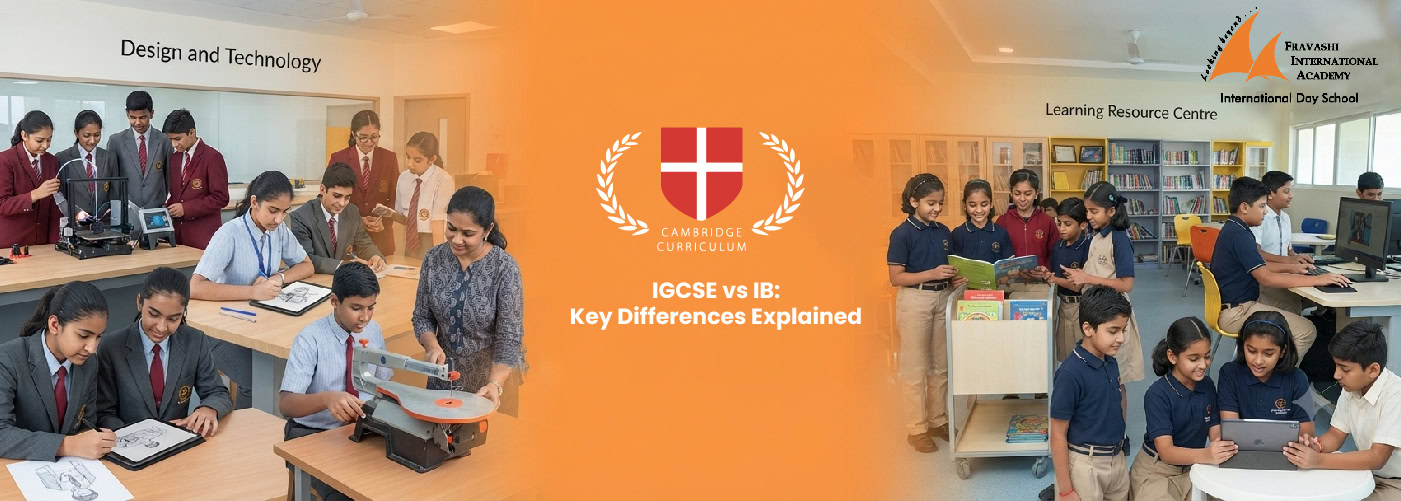
Parents comparing international curricula often encounter two acronyms: IGCSE and IB. Both are globally respected, but they differ in structure, assessment, subject choice, and the type of learning experience they provide.
This guide explains the key differences between IGCSE and IB to help parents understand the two pathways and consider which approach may align with their child’s learning style, academic interests, and future plans.
For families in Nashik, the comparison is particularly relevant because Fravashi International Academy (FIA) offers the Cambridge pathway, including IGCSE and advanced Cambridge qualifications, rather than the IB curriculum.
What Are IGCSE and IB?
What Is IGCSE?
IGCSE (International General Certificate of Secondary Education) is typically a two-year programme taken around Grades 9–10. Offered by Cambridge International, it prepares students for advanced study such as Cambridge International AS & A Levels.
The programme focuses on individual subjects and provides students with flexibility in selecting combinations aligned with their strengths and future interests.
What Is IB?
International Baccalaureate (IB) is an umbrella framework covering several programmes.
For secondary and pre-university students, parents commonly compare:
- IB Middle Years Programme (MYP): Generally for students aged around 11–16
- IB Diploma Programme (DP): A two-year pre-university programme generally taken around Grades 11–12
The IB framework places strong emphasis on inquiry, international-mindedness, interdisciplinary learning, and broader academic development.
Important: FIA offers the Cambridge pathway rather than IB. This comparison is intended to help parents understand the differences between the two international education approaches.
Age Range and Progression
The two pathways differ considerably in their structure and progression.
IGCSE
IGCSE is typically undertaken by students around ages 14–16 or Grades 9–10.
A common Cambridge progression is:
Cambridge Lower Secondary → IGCSE → Cambridge International AS & A Levels → University
Parents can explore FIA’s Cambridge Lower Secondary pathway to understand the stage that can lead into the IGCSE years.
IB
The IB pathway includes:
- MYP: Approximately ages 11–16 or Grades 6–10
- DP: Approximately ages 16–19 or Grades 11–12
The MYP may culminate in an optional eAssessment, while the DP is a two-year pre-university programme.
What This Means for Parents
IGCSE is a subject-based qualification generally completed at the end of Grade 10.
IB MYP is a broader educational framework and does not correspond directly to a single external qualification equivalent to IGCSE.
The IB Diploma Programme is closer in level to Cambridge International AS & A Levels than to IGCSE.
Subjects and Flexibility
Subject structure is one of the most noticeable differences between the two pathways.
IGCSE Subject Choice
IGCSE allows students to select subjects across areas such as:
- Languages
- Sciences
- Mathematics
- Humanities
- Creative subjects
- Technical or vocational subjects
Students can develop depth within individual disciplines. Examples include separate Physics, Chemistry, and Biology syllabi, along with different mathematics options and electives such as Business Studies, ICT, and Art & Design.
For parents considering subject combinations, FIA provides guidance through its Cambridge IGCSE subject choices resource.
IB Subject Structure
The IB structure is broader.
The MYP covers multiple subject groups with an interdisciplinary focus and includes a Personal Project designed to encourage independent inquiry.
The IB Diploma Programme requires students to select six subjects across subject groups, alongside three core components:
- Theory of Knowledge (TOK)
- Extended Essay (EE)
- Creativity, Activity, Service (CAS)
Key Difference
In broad terms:
IGCSE: Greater flexibility to develop depth through individual subject choices.
IB: Greater emphasis on breadth, interdisciplinary learning, and mandatory core components.
Assessment Style and Grading
The two pathways also differ in how student learning is assessed.
IGCSE Assessment
IGCSE commonly includes external examinations at the end of the two-year programme, with coursework or practical components depending on the subject.
Assessment can test:
- Subject knowledge
- Application
- Structured problem-solving
- Practical skills
- Subject-specific understanding
IGCSE grading may use a 9–1 or A–G* scale depending on the syllabus and assessment structure.
Parents interested in understanding Cambridge assessment in greater detail can explore how Cambridge assessments and grading work.
IB Assessment
IB assessment combines different components.
For the Diploma Programme, students complete:
- Internal assessments
- External examinations
- Theory of Knowledge
- Extended Essay
- Subject-specific assessments
The DP uses a 1–7 score for individual subjects, with additional points available from the core components, giving a maximum of 45 points.
What This Means
IGCSE assessment generally concentrates on subject-level knowledge and application.
IB incorporates coursework, research, reflection, and core components alongside examinations.
Skills Developed
Both pathways can develop academic and transferable skills, although the emphasis differs.
IGCSE Strengths
IGCSE can support the development of:
- Strong subject knowledge
- Examination skills
- Analytical thinking
- Practical laboratory skills
- Subject-specific problem-solving
- Preparation for specialized pre-university study
It also provides a clear progression toward Cambridge International AS & A Levels.
Students can further develop analytical abilities through FIA’s focus on critical thinking skills.
IB Strengths
The IB framework places significant emphasis on:
- Interdisciplinary thinking
- Research
- Academic writing
- Community engagement
- Leadership
- Breadth across disciplines
TOK, the Extended Essay, and CAS contribute to this broader learning experience.
Both Pathways
Both approaches can support critical thinking and global awareness.
The difference lies more in how those skills are developed and structured.
IGCSE tends to provide greater subject-level depth and choice, while IB places stronger emphasis on breadth, interdisciplinary work, research, and structured core components.
University Recognition and Pathways
IGCSE
IGCSE is a widely recognized Grade 10 qualification.
When followed by Cambridge International AS & A Levels, it forms part of a pathway toward university study in the UK, India, North America, Europe, and other regions.
The source material distinguishes IGCSE from post-16 qualifications: universities generally assess pre-university qualifications such as A Levels or the IB Diploma for undergraduate entry, while IGCSE represents the student’s Grade 10 achievement and preparation for further study.
Parents can learn more about the Cambridge Upper Secondary IGCSE curriculum and its role within the broader Cambridge pathway.
IB Diploma Programme
The IB Diploma is a comprehensive pre-university qualification with standardized scoring and is recognized by universities internationally.
For both pathways, students should check individual university and course requirements because subject prerequisites can vary.
Workload and Learning Experience
IGCSE
IGCSE generally involves a focused workload across selected subjects.
Students manage depth within their chosen subjects and may benefit from a clear syllabus and defined examination structure.
This can suit learners who prefer:
- Clear academic goals
- Subject specialization
- Structured examination preparation
- Greater choice between subjects
IB Diploma Programme
The IB Diploma involves six subjects alongside TOK, the Extended Essay, and CAS.
This creates a sustained workload involving:
- Academic study
- Research
- Writing
- Reflection
- Projects
- Community and extracurricular engagement
This can suit learners who enjoy breadth, interdisciplinary learning, long-term projects, and independent research.
Cost, Availability, and School Fit
Curriculum choice should not be based on the programme name alone.
Parents should also evaluate:
- School authorization
- Teacher expertise
- Academic support
- Learning facilities
- Student support systems
- Extracurricular opportunities
- University guidance
- Learning environment
In Nashik, FIA delivers the Cambridge pathway with infrastructure and trained faculty supporting IGCSE and advanced stages.
Parents can explore FIA’s Cambridge IGCSE school experience in Nashik to understand how the Cambridge pathway is delivered locally.
Practical Tips for Choosing Between IGCSE and IB
Rather than asking which curriculum is universally better, consider how each pathway aligns with the individual learner and the school providing it.
Consider Your Child’s Strengths
A student who enjoys:
- Strong subject interests
- Structured learning
- Subject-specific depth
- Examination-based assessment
may find the IGCSE pathway aligned with their preferences.
A student who enjoys:
- Breadth
- Research
- Interdisciplinary projects
- Long-term assignments
- Service activities
may prefer the characteristics associated with the IB pathway, where it is available.
Map the Long-Term Route
Common progression patterns include:
IGCSE → Cambridge International AS & A Levels → University
and
IB MYP → IB Diploma Programme → University
Understanding the complete pathway is important because IGCSE and IB MYP are not direct equivalents at every stage.
Look at Evidence
When comparing schools, consider:
- Past academic results
- Teacher qualifications
- Student support
- Science and learning facilities
- Sports facilities
- Extracurricular opportunities
- Global engagement
- University guidance
The curriculum label is only one part of the overall educational experience.
How Fravashi International Academy Supports Cambridge Learners
Fravashi International Academy in Nashik offers the Cambridge curriculum in a student-centric environment that combines academic learning with broader student development.
Cambridge Pathway Alignment
FIA provides a structured progression through Cambridge stages, from lower secondary through IGCSE and advanced Cambridge qualifications.
Explore the Cambridge pathway at FIA to understand how the different stages connect.
Holistic Growth
Sports, clubs, arts, leadership opportunities, and other activities complement academic development.
Parents can explore student life at FIA to understand the wider school experience.
Modern Learning Infrastructure
Science laboratories, digital learning tools, and contemporary classrooms can support practical and inquiry-based learning.
Explore FIA’s learning infrastructure for more information.
International Exposure
Global perspectives embedded in teaching and intercultural learning experiences can help students develop broader awareness and confidence.
Guidance and Counselling
Academic planning and university guidance can help students and families navigate subject choices and future applications.
IGCSE vs IB at a Glance
| Area | IGCSE | IB |
|---|---|---|
| Structure | Subject-based qualification | MYP framework and DP qualification |
| Typical stage | Grades 9–10 | MYP: Grades 6–10; DP: Grades 11–12 |
| Subject approach | Flexible subject selection and depth | Broader, interdisciplinary structure |
| Assessment | Primarily examinations, with subject-specific coursework/practical components | Internal assessment, external examinations, and core components |
| Key components | Individual subject syllabi | TOK, Extended Essay, CAS in DP |
| Progression | IGCSE → AS & A Levels → University | MYP → DP → University |
| Learning emphasis | Subject knowledge, application, depth | Breadth, inquiry, research, interdisciplinary learning |
| Best fit depends on | Subject interests, preferred learning style, future goals | Interest in breadth, research, projects, and interdisciplinary learning |
The comparison should be viewed as a framework for understanding the two systems rather than a universal judgement about either curriculum.
FAQs
Is IGCSE Equivalent to Grade 10 Board Exams in India?
IGCSE is an international qualification generally completed around the Grade 10 level.
Students and parents should check the current equivalence and transition requirements applicable to their intended institution or university.
Do Universities Prefer A Levels or IB Diploma?
Both A Levels and the IB Diploma are widely recognized internationally.
Preferences and requirements can vary according to country, university, and degree programme. Students should check the individual university’s published requirements.
Can an IGCSE Student Switch to IB DP Later?
It may be possible in some cases, but the transition depends on the receiving school’s policies, subject mapping, and the student’s academic preparation.
Students following the Cambridge pathway commonly progress from IGCSE to Cambridge International AS & A Levels.
Which Curriculum Is Better for STEM?
Both pathways can support STEM progression.
IGCSE followed by A Levels can allow students to develop depth in Mathematics and Sciences, while the IB Diploma offers Higher Level subjects and laboratory-based learning within its broader framework.
The appropriate choice depends on the student’s learning preferences, intended degree, subject requirements, and the strengths of the school delivering the programme.
How Many Subjects Are Taken in IGCSE?
The number varies by school and student programme. The source material indicates that many students take around 6–9 IGCSE subjects, balancing core areas with electives aligned with future goals.
References
- Cambridge International — Cambridge Upper Secondary
- Cambridge International — Recognition
- International Baccalaureate — Programmes
- UNESCO — Education
Take the Next Step
Choosing an international curriculum is an important decision, and the right pathway depends on your child’s academic interests, learning preferences, future plans, and the support available at the school.
If you are considering the Cambridge IGCSE pathway in Nashik, explore Cambridge IGCSE at Fravashi International Academy or contact FIA to discuss subject choices, progression, and admissions.

Leave A Comment