
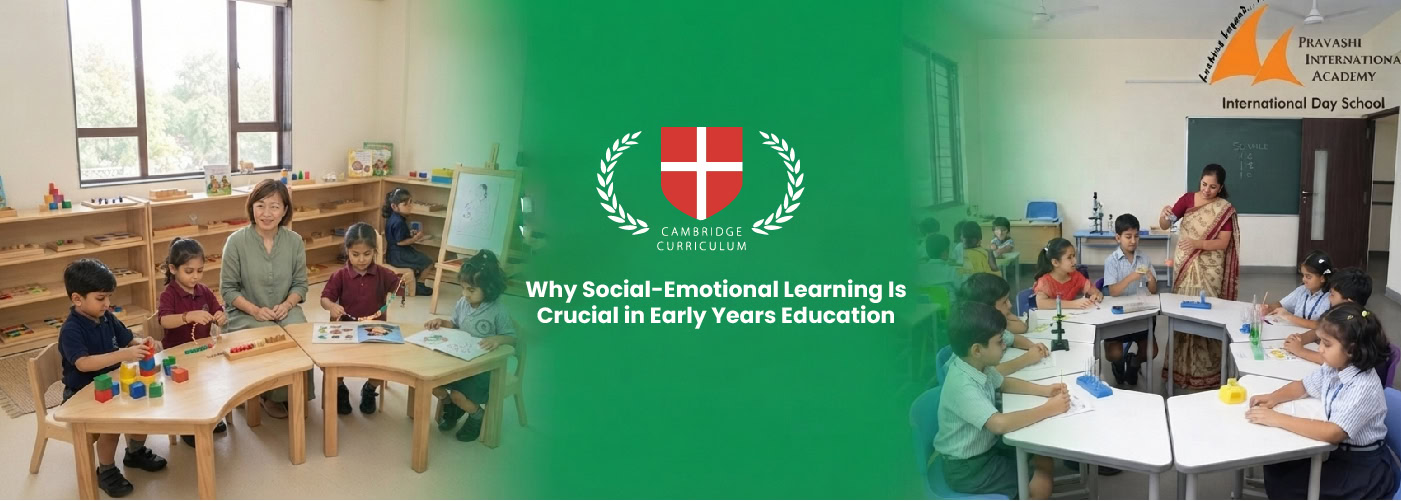
Parents today want more than academics from an early childhood programme—they want their children to grow into confident, empathetic, and resilient learners.
That’s where social-emotional learning (SEL) in the early years becomes foundational. In preschool and the first years of primary school, children begin developing the emotional intelligence and self-regulation skills that can support lifelong wellbeing and academic learning.
This guide explains what SEL is, why it matters in early childhood, how families can nurture it at home, and what effective school practices can look like.
What Is Social-Emotional Learning (SEL)?
Social-emotional learning is the process through which children develop the knowledge, attitudes, and skills to:
- Understand and manage their emotions through self-awareness and self-management
- Show empathy for others through social awareness
- Build positive relationships through relationship skills
- Make responsible and ethical choices through responsible decision-making
In early childhood, SEL can look like:
- Naming feelings
- Taking turns
- Waiting patiently
- Cooperating during play
- Using words to solve conflicts
- Asking for help
- Bouncing back after small setbacks
These everyday experiences give young children opportunities to practise emotional and social skills in situations that are meaningful to them.
Why SEL Matters in Early Childhood
Brain Development
The early years are an important period for developing skills related to attention, impulse control, emotional regulation, and empathy.
Early SEL experiences can give children practical tools for managing emotions and behaviour, which can support their ability to participate in learning activities such as literacy and numeracy.
School Readiness and Academic Learning
Children who develop stronger social-emotional skills can be better prepared to engage in classroom activities, persist through challenges, cooperate with peers, and participate in learning.
These behaviours can support learning across areas including reading, mathematics, communication, and inquiry.
Behaviour and Wellbeing
Young children experience big emotions while still learning how to understand and regulate them.
SEL gives children age-appropriate strategies for managing feelings, navigating social situations, and responding to everyday challenges.
Lifelong Competencies
Skills such as empathy, cooperation, communication, and responsible decision-making can continue to be relevant as children grow.
They can contribute to relationships, leadership, collaboration, and participation in wider communities.
Authoritative research and educational frameworks continue to examine connections between social-emotional learning, classroom environments, behaviour, and longer-term development. The references at the end of this article provide further reading.
The Five Core SEL Competencies for Young Children
1. Self-Awareness
Self-awareness involves recognising and describing emotions and beginning to understand how feelings affect behaviour.
For young children, this might include recognising feelings such as:
- Happy
- Sad
- Angry
- Scared
- Excited
- Frustrated
Children can also begin noticing physical signals associated with emotions, such as a tight stomach or a fast heartbeat.
2. Self-Management
Self-management involves developing strategies for handling emotions and behaviour.
Age-appropriate examples include:
- Taking deep breaths
- Counting to five
- Asking for help
- Following familiar routines
- Waiting for a turn
- Moving to a quiet space when needed
3. Social Awareness
Social awareness involves recognising that other people have feelings, needs, experiences, and perspectives that may be different from our own.
Young children can practise this through:
- Kind language
- Sharing
- Inclusion
- Understanding fairness
- Noticing how others feel
4. Relationship Skills
Relationship skills develop through everyday interactions with adults and other children.
Children can practise:
- Listening
- Sharing
- Cooperating
- Taking turns
- Resolving conflicts with adult guidance
- Building friendships
5. Responsible Decision-Making
Responsible decision-making involves helping children understand the consequences of their choices and encouraging safe, fair behaviour.
Examples include:
- Using gentle hands
- Cleaning up toys
- Making safe choices
- Telling the truth
- Considering how actions affect others
In practice, these competencies develop through play, routines, storytelling, and warm, consistent adult support.
How Parents Can Foster SEL at Home
Families can reinforce social-emotional development through simple everyday interactions.
Name Feelings in the Moment
Instead of dismissing a child’s frustration, acknowledge it and give the feeling a name.
For example:
“You’re frustrated because the block tower fell. Let’s try again together.”
This helps children connect experiences with emotional vocabulary.
Build Predictable Routines
Morning and bedtime routines can reduce uncertainty and give children a stronger sense of structure and control.
Visual schedules and simple charts can help younger children understand what happens next.
Practise Calming Strategies
Families can introduce simple strategies such as:
- Belly breathing
- Five-finger tracing
- Stretching
- Quiet reading
- Spending time with soft toys
- Taking a short break in a calm space
Use Stories and Play
Picture books, storytelling, puppets, and role-play can help children explore emotions and possible solutions in a safe environment.
FIA’s focus on early childhood learning can also be explored through its Cambridge Early Years programme.
Model and Narrate
Children learn from observing adults.
Parents can model how they handle disappointment, frustration, mistakes, and apologies while explaining what they are doing.
Encourage Problem-Solving
Rather than immediately fixing every problem, ask:
“What could we try?”
This encourages children to think about possible solutions while still receiving appropriate adult support.
Practise Mindful Screen Use
Parents can co-view age-appropriate content, discuss how characters feel, and balance screen time with active, social, creative, and outdoor play.
What Effective SEL Looks Like in Schools
High-quality early years programmes can integrate SEL into everyday teaching rather than treating it as a separate activity.
When evaluating an early years programme, parents can look for the following:
Play-Based Learning
Dramatic play, block building, collaborative activities, and group projects can give children opportunities to practise cooperation, turn-taking, communication, and problem-solving.
Parents interested in the role of play within Cambridge education can also explore the key features of the Cambridge Early Years curriculum.
Emotion-Rich Routines
Morning meetings, feeling charts, check-ins, and classroom conversations can normalise talking about emotions.
Positive Behaviour Support
Clear expectations, visual cues, consistent routines, and restorative approaches can help children understand behaviour without relying primarily on punitive responses.
Teacher Training
Educators need appropriate skills to support co-regulation, de-escalation, communication, and children’s individual developmental needs.
Inclusive Environments
Respect for different backgrounds, experiences, cultures, and perspectives can help children develop empathy and social awareness.
Assessment for Learning
Observation and portfolios can provide opportunities to understand children’s development in areas such as self-regulation and social interaction without relying exclusively on formal testing.
Family Partnership
Workshops, regular communication, and practical strategies that can be used at home help create consistency between school and family environments.
SEL at Fravashi International Academy: Holistic Foundations in the Early Years
As an international school in Nashik offering the Cambridge pathway, Fravashi International Academy focuses on a student-centred learning environment that supports academic and broader development.
Cambridge-Aligned, Student-Centric Classrooms
The Cambridge approach at FIA incorporates inquiry, reflection, communication, and collaboration into the learning experience.
These experiences can create opportunities for children to practise self-awareness, communication, cooperation, and problem-solving.
Learn more about the Cambridge Early Years curriculum at FIA and how the early childhood pathway is structured.
Holistic Development
SEL does not happen only during classroom activities.
Sports, arts, clubs, activities, and other experiences can give students opportunities to develop teamwork, resilience, communication, and leadership.
Explore Life at FIA to learn more about the broader student experience.
International Exposure
Global themes and intercultural learning can expose children to different perspectives and encourage empathy, curiosity, and social awareness.
Learning Environment and Infrastructure
Purpose-built learning spaces can support collaborative activities, movement, exploration, and age-appropriate opportunities for children to regulate and refocus.
Parents can explore FIA’s infrastructure for more information about the school’s learning environment.
Teacher Guidance and Wellbeing
Everyday routines such as circle time, buddy activities, and age-appropriate reflection can provide opportunities to practise SEL skills.
For young learners, these experiences may use visual prompts, stories, conversations, and other developmentally appropriate approaches.
Family Partnership
Parent orientations and ongoing communication can help families and educators use consistent language and strategies when supporting children’s emotional and social development.
Together, these elements can create an environment where young children practise emotional literacy, build friendships, develop confidence, and feel supported as they explore and learn.
Examples of SEL in FIA’s Early Years Classrooms
Examples of activities that can support social-emotional development include:
- Morning circles: Feeling cards can help children build emotional vocabulary.
- Choice time: Cooperative learning centres can encourage sharing, negotiation, and communication.
- Sports and movement: Games can introduce concepts such as fair play, cooperation, and sportsmanship.
- Storytelling and puppetry: Stories can provide opportunities to explore empathy and problem-solving.
- Quiet zones: Calm spaces can give children opportunities to pause, settle, and reflect.
How to Choose an Early Years Programme With Strong SEL
When visiting schools, parents can ask:
- How do teachers help children name and manage emotions?
- What routines support calm transitions and conflict resolution?
- How are SEL skills observed and communicated to families?
- How are diversity and inclusion represented in classroom materials and activities?
- How do sports, arts, and outdoor play contribute to teamwork and resilience?
- What training do teachers receive in SEL and child development?
Parents should look for consistency between what a school says about SEL and what they observe during a school visit.
Signs may include:
- Warm teacher-child interactions
- Consistent emotional vocabulary
- Collaborative and play-based learning
- Predictable classroom routines
- Opportunities for children to make choices
- Appropriate support when children experience conflict or frustration
Frequently Asked Questions
Is SEL Age-Appropriate for Preschoolers?
Yes. In early years settings, SEL can be concrete, practical, and playful.
Children can learn to name feelings, take turns, communicate their needs, and use simple calming strategies with appropriate adult support.
Will Focusing on SEL Take Time Away From Academics?
SEL and academic learning do not need to be treated as competing priorities.
Skills such as attention, persistence, communication, cooperation, and self-regulation can support children’s participation in literacy, numeracy, inquiry, and other learning experiences.
How Can I Tell if My Child’s SEL Is on Track?
Look for gradual development in areas such as:
- Waiting
- Sharing
- Calming after frustration
- Expressing needs with words
- Cooperating with others
- Recovering from small setbacks
Teacher observations and parent-teacher conversations can provide additional context about a child’s development.
What If My Child Has Big Emotions or Frequent Conflicts?
Big emotions and conflicts can be part of early childhood development.
Consistent routines, co-regulation, calm communication, clear boundaries, and appropriate adult support can help children develop these skills over time.
If parents have ongoing concerns about their child’s development or behaviour, they should discuss them with an appropriate early childhood professional.
Does SEL Look Different in an International School?
The core social-emotional skills are relevant across educational settings.
However, international curricula can provide additional opportunities to explore different perspectives, cultures, and global themes, which may contribute to social awareness and intercultural understanding.
References and Further Reading
- Cambridge International — Social and Emotional Learning
- UNESCO — Social and Emotional Learning for All
- OECD — Social and Emotional Skills Study
Conclusion
Early social-emotional learning provides an important foundation for how children learn, communicate, relate to others, and respond to everyday challenges.
In the early years, children can practise empathy, self-management, cooperation, and problem-solving through play, routines, stories, relationships, and supportive adult guidance.
For families exploring an international education pathway in Nashik, Fravashi International Academy combines its Cambridge approach with broader opportunities for student development. Parents can learn more about Cambridge Early Years at FIA or contact Fravashi International Academy to explore the early years learning environment.

Leave A Comment